HARMONICS OF BELONGING, USC
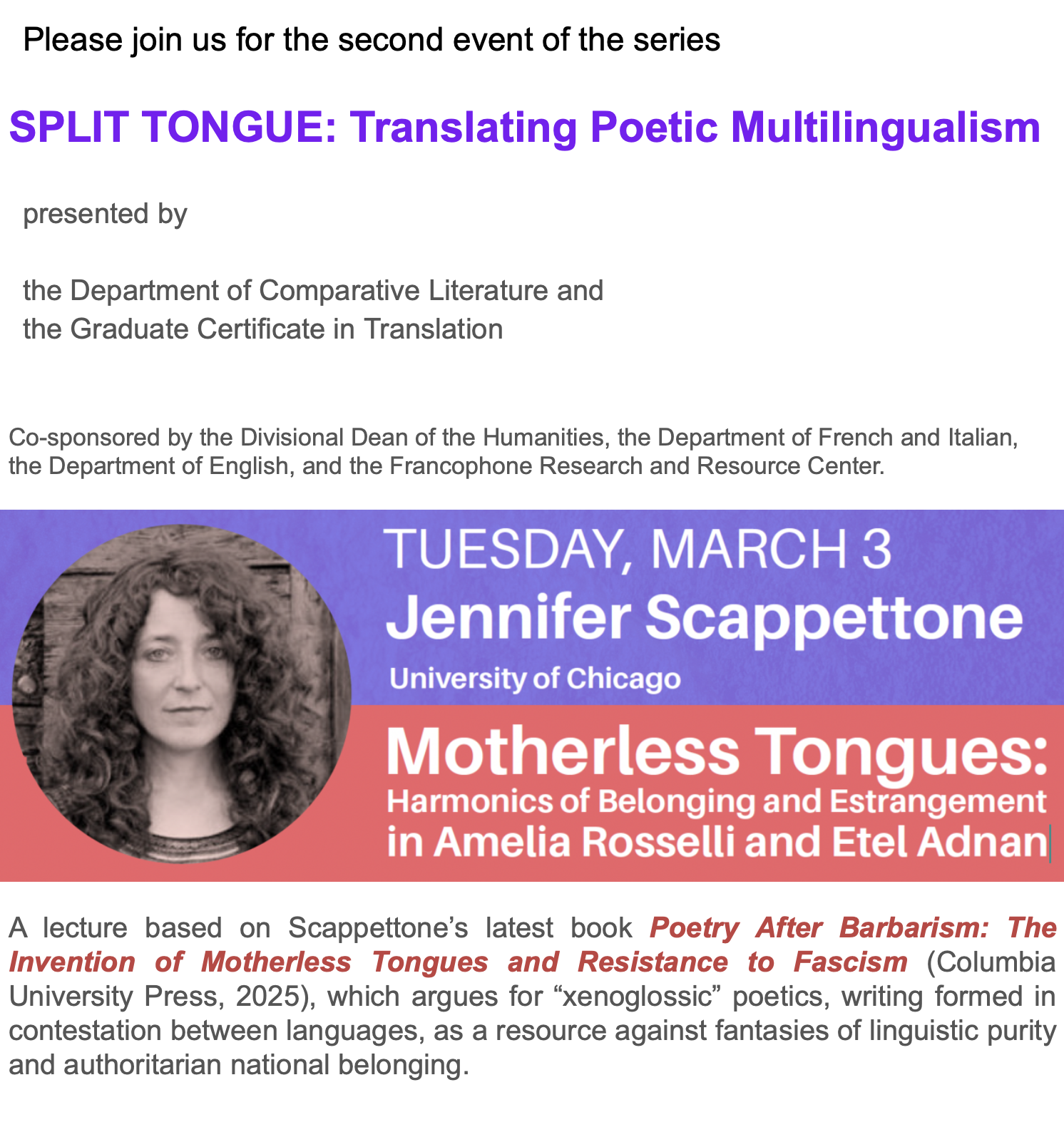
Please join us for the second event of the series
SPLIT TONGUE: Translating Poetic Multilingualism
presented by
the Department of Comparative Literature and
the Graduate Certificate in Translation
Co-sponsored by the Divisional Dean of the Humanities, the Department of French and Italian, the Department of English, and the Francophone Research and Resource Center.
THH 309K, 3:00pm-4:30pm
Amelia Rosselli
Amelia Rosselli (1930-1996) is considered to be one of the best Italian writers of the post-WWII generation. She was born in Paris to Italian parents who fled Italy. Her father and uncle, who were leaders of the anti-Fascist Resistance, were assassinated by the Fascist secret service when she was seven years old. Rosselli published eight poetry collections, writing in English, French, and Italian. Her work has been collected in Locomotrix: Selected Poetry and Prose of Amelia Rosselli (2012, translated by Jennifer Scappettone).
Etel Adnan
Poet, essayist, and painter Etel Adnan was born in Beirut, Lebanon. The daughter of a Greek Christian mother and a Syrian Muslim father, she spoke both Greek and Arabic with her parents, but French became her primary language. Her many collections of poetry include Shifting the Silence (2020); Time (2019), winner of the Griffin Poetry Prize; Surge (2018); Night (2016); Seasons (2008); There: In the Light and the Darkness of the Self and the Other (1997); The Spring Flowers Own & Manifestations of the Voyage (1990); The Indian Never Had a Horse (1985); and Moonshots (1966).
Jennifer Scappettone
is a professor of literature, creative writing, gender studies, and environmental humanities at the University of Chicago. She works at the confluence of the literary, scholarly, visual, and performing arts. She has authored the critical studies Killing the Moonlight: Modernism in Venice and Poetry After Barbarism: The Invention of Motherless Tongues and Anti-Fascist Resistance (Columbia University Press, 2025). As a translator she has published Locomotrix, devoted to the poet-refugee from Fascist Italy Amelia Rosselli (University of Chicago Press, 2012), and she curates PennSound | Italiana. She is the author of the poetry collections The Republic of Exit 43: Outtakes & Scores from an Archaeology and Pop-Up Opera of the Corporate Dump (Atelos, 2016), From Dame Quickly, and Smokepenny Lyrichord Heavenbred: Two Acts from (The Elephants, 2018) and editor of Belladonna Elders Series: Poetry, Landscape, Apocalypse (with Etel Adnan and Lyn Hejinian, Belladonna, 2009).
Poetry after Barbarism
Columbia University Press, 2025
Against a backdrop of xenophobic and ethnonationalist fantasies of linguistic purity, Poetry After Barbarism uncovers a stateless, polyglot poetry of resistance—the poetry of motherless tongues.
Authors who write xenoglossic verse occupy languages without a perceived birthright or sanctioned education; they compose in ecstatic “orphan tongues” that rebuff nationalist ideologies, on the one hand, and globalization, on the other, uprooting notions of belonging ensconced in nativist metaphors of milk, blood, and soil while rendering the reactionary category of the barbarian obsolete. Raised within or in the wake of fascism, these poets practice strategic forms of literary and linguistic barbarism, proposing modes of collectivity that exceed geopolitical definitions. Studying experiments between languages by immigrant, refugee, and otherwise stateless authors—from Baroness Elsa von Freytag-Loringhoven to Emilio Villa, Amelia Rosselli, Etel Adnan, LaTasha N. Nevada Diggs, Chika Sagawa, and Sawako Nakayasu—this book explores how poetry can both represent and jumpstart metamorphosis of the shape and sound of citizenship, modeling paths toward alternative republics in which poetry might assume a central agency.